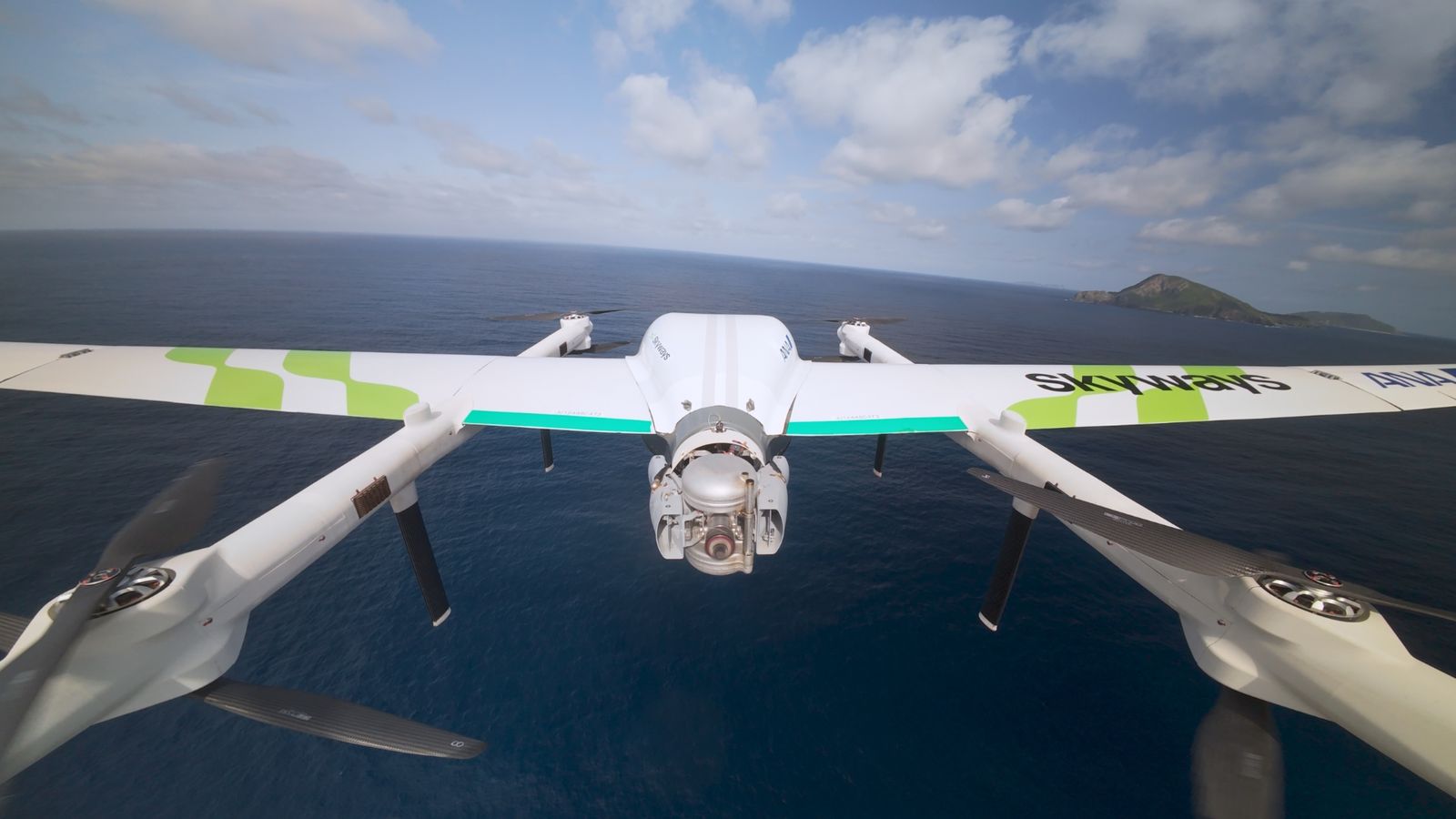
On Kumejima Island, 90 kilometers west of Okinawa's main hub, a child's asthma inhaler isn't a pharmacy trip – it's a week-long wait. A birthday gift for your mother means a ferry ride, an overnight stay, and a day's wages lost. The manga magazine your son wants? It arrives two weeks after publication, if the distributor bothers shipping to a small island at all.
Thousands of Japanese islands operate this way. Pharmacies stock what they can store. Retailers skip locations that don't justify freight costs. Critical supplies move on ship schedules designed for bulk, not urgency.

The result is attrition. Young families leave for cities where same-day delivery is baseline. Island populations age and shrink. Cultural roots remain strong, but modern expectations – access to goods, services, healthcare – pull people toward urban centers that can deliver them.
That's changing now. Autonomous aircraft designed for long-range island routes are reaching places conventional transportation can't serve economically. And the infrastructure is already flying.
ANA Holdings Inc. had been searching for a solution to island logistics for years. What they needed was range, payload, and reliability over water – capabilities small drones and helicopters couldn't deliver with viable economics.
"We wanted long distance, large payload, and the ability to fly to moving ships," Yuji Hirose, who leads ANA's drone operations, explains. "We researched all around the world. I found Skyways through articles in the media."

The connection was made through Mitsui Bussan Aerospace, one of Japan's major trading firms. What convinced ANA once the conversation started? Skyways had already demonstrated similar operations with the US Navy – proven technology, real operations. ANA sent crews to the United States for training. Skyways deployed teams to Japan. They flew the missions: ship resupply, 150-kilometer island runs, operations in distant waters off the coast of Japan. The aircraft, autonomy, and procedures all held.
That validation opened commercial doors. The same aircraft, routes, and trained crews could serve cargo delivery. Defense proved the technology in demanding conditions. Commercial operations would drive sustainable economics.
Japan comprises thousands of islands stretching from Hokkaido to Okinawa. Many lack airports. Ferry service is infrequent. Conventional logistics can take days or weeks.

Skyways’ hybrid-VTOL architecture addresses the specific combination of constraints other platforms can’t reconcile: range over water, vertical launch from unprepared sites, and autonomous operations with minimal ground crew. Vertical takeoff and landing means no runway required – launch from a parking lot or warehouse roof. Fixed-wing cruise covers hundreds of miles efficiently. The combination enables point-to-point delivery without the infrastructure conventional aviation demands.
The hybrid powerplant also provides critical safety over water. Electric systems handle vertical flight; an internal combustion engine powers cruise. The systems operate independently. If the cruise engine fails, VTOL systems still function for controlled landing.

"We have electric power to take off, and forward flight for extremely long range cruise," explains Alberto Gomez, Flight Test Operator at Skyways. "The flight computer and VTOL power don't depend on the cruise engine. If the cruise engine fails, Skyways will still land safely."
Autonomy reduces operational footprint. Computer vision handles navigation and precision landing. One trained operator can oversee operations from a flight center without extensive ground crews at every destination.
Skyways aircraft have flown consistently between Naha and Kumejima – 90 kilometers over open water, through whatever the Pacific delivers that morning. The Skyways V2 hybrid eVTOL, with ~450 miles of range and up to 30 lbs of useful load, proved itself in defense missions and now carries commercial cargo on the same island routes. The next-generation V3, with up to 860 miles of range at a 50 lbs payload and up to 105 lbs max useful load, will expand what's possible across longer routes. Week-long waits become same-day delivery.
ANA is working with commercial logistics partners to scale the network across island communities in Okinawa and other regions where conventional delivery has never been economically viable.

The cadence matters as much as the capability. Anyone can complete a single flight successfully. The real test is doing it day after day – through shifting winds, changing weather windows, and the operational variables that only surface when you show up every morning and fly the route again.
"We've been flying frequently to Kumejima for weeks now, and we're scaling to multiple flights per day," Charles Acknin, Skyways founder and CEO explains. "It's one thing to prove you can make the trip. It's another to prove you can make it reliably, repeatedly, through conditions that change every day. That's what builds the operational foundation to scale – and that's what we're proving right now."
Every flight generates data feeding back into Skyways' autonomy systems, improving reliability and expanding operational envelopes. "By being here every day, as often as we can, we collect real-world data," Gomez emphasizes. "We experience failures and performance in real-world, not just simulations. That way, when we tell customers this aircraft will fly hundreds of miles with no issues, that's what happens."
For island residents, the impact is tangible. Pharmacies order supplies with confidence they'll arrive quickly. Families access goods without traveling to the main island. Local businesses have reliable logistics they can depend on.
The reason autonomous cargo works now comes down to cost structure. Traditional helicopter logistics – like an MH-60 Seahawk sortie – drive significant cost per flight hour and a full crew. For small payloads, the economics don't work. Most missions don't fly because they can't pencil.

Autonomous aircraft operations save 90%+ per flight hour versus helicopters with no aircrew required. Missions that never made economic sense become viable.
"Before Skyways we didn't have any solution with drones because nobody thought we'd be able to have long-distance drone transportation," Yuji explains. "It was all helicopter. We'd transport 5 kilograms by helicopter at a huge cost."
Scale compounds the advantage. Skyways and ANA are working toward one operator overseeing multiple aircraft , reducing human resource costs that represent 40-50% of operations in Japan. "Having a single operator able to oversee five aircraft or 10 aircraft, 15 aircraft, we're able to reduce the human resource costs a lot," Yuji notes.
Mass production lowers aircraft costs, higher utilization spreads fixed costs across more flights, and increasing autonomy reduces crew ratios. Defense operations helped de-risk the commercial investment – ANA saw the technology work in demanding conditions and took a significant equity position in Skyways, aligning incentives for long-term scale. The partnership positions both companies for growth as autonomous cargo infrastructure expands across Japan.
The consistent flights to Kumejima are proving more than a single route. They're proving the model for something fundamentally different from conventional logistics: a distributed delivery network where autonomous aircraft operate from a few strategically located hubs, making precision deliveries to specific locations across dozens of islands simultaneously.

This isn't hub-to-hub routing. It's precision delivery to nearly arbitrary GPS coordinates: a remote clinic, a fishing port, a community without a runway or a ferry schedule that serves it. If there are coordinates and space for a precision drop or landing, the network can reach it. One operator overseeing multiple aircraft from a regional hub changes the economics from interesting to transformational.
That's the network Skyways and ANA are building. Medical supplies to an island hospital that currently waits days. Parts to a vessel offshore. Critical cargo to communities where conventional logistics simply don’t work. The delivery location stops being a constraint and starts being a coordinate.
"It's going to be a new infrastructure in Japan," Yuji says. "Skyways network will be a new infrastructure in Japan."

ANA and Skyways are working with Japan's aviation authorities on approvals for expanded operations, including type certification required for routes over populated areas. The operational model and technology proven in Japan become a template exportable to any island geography worldwide – Indonesia, the Philippines, Greece, the Caribbean, and so on.
For the child on Kumejima waiting for an inhaler, or the family ordering a birthday gift, or the teenager wanting this week's manga magazine, the transformation is already underway. The flights are happening. The routes are expanding. And the logistics infrastructure is starting to serve everyone, not just those living in cities.
What is ANA's role in autonomous cargo operations?
ANA operates Skyways aircraft for cargo delivery across Japan's island regions. ANA procures aircraft, trains operators, manages flight operations, and coordinates with logistics partners. Skyways provides the technology, autonomy systems, and software updates.
How much does autonomous cargo delivery cost compared to traditional methods?
Autonomous operations save 90%+ per flight hour compared to a traditional helicopter sortie, with no aircrew required – making small-payload deliveries economically viable for the first time.
Can autonomous aircraft operate safely over water and to remote islands?
Yes. Skyways' hybrid powerplant provides redundancy – if the cruise engine fails, VTOL electric systems still function for controlled landing. The aircraft uses computer vision for navigation and has demonstrated reliable operations over water across hundreds of kilometers.
Why do Japan's islands create logistics challenges?
Japan comprises thousands of islands, many lacking airports or frequent ferry service. Conventional logistics take days or weeks. The cost structure of traditional air transport makes small-payload deliveries unviable, leaving island communities underserved.
What types of goods are being delivered to remote islands?
Current operations focus on items with high time value. Planned applications include medical supplies for emergency situations, including blood products that require rapid delivery to remote hospitals.
How does ANA plan to scale autonomous cargo operations?
The strategy expands from initial routes to a growing network of island routes from regional hubs. ANA is moving from one-to-one supervision to one operator overseeing multiple aircraft, reducing labor costs while increasing route density. Mass production and regulatory approvals enable further scaling.
Why did ANA choose to partner with Skyways?
After operational deployments demonstrated reliability in demanding conditions – including ship resupply and long-range island missions – ANA committed to a long-term partnership with Skyways. The collaboration enables ANA to scale autonomous cargo operations across Japan while Skyways continues developing autonomy that improves with every flight. The partnership reflects ANA's vision of autonomous cargo becoming core infrastructure for Japan's island communities.
Ten minutes into our first conversation, you’ll know you found the right partner. We ask the right questions, identify and propose the best solutions, and follow through down to the detail with exemplary build quality.