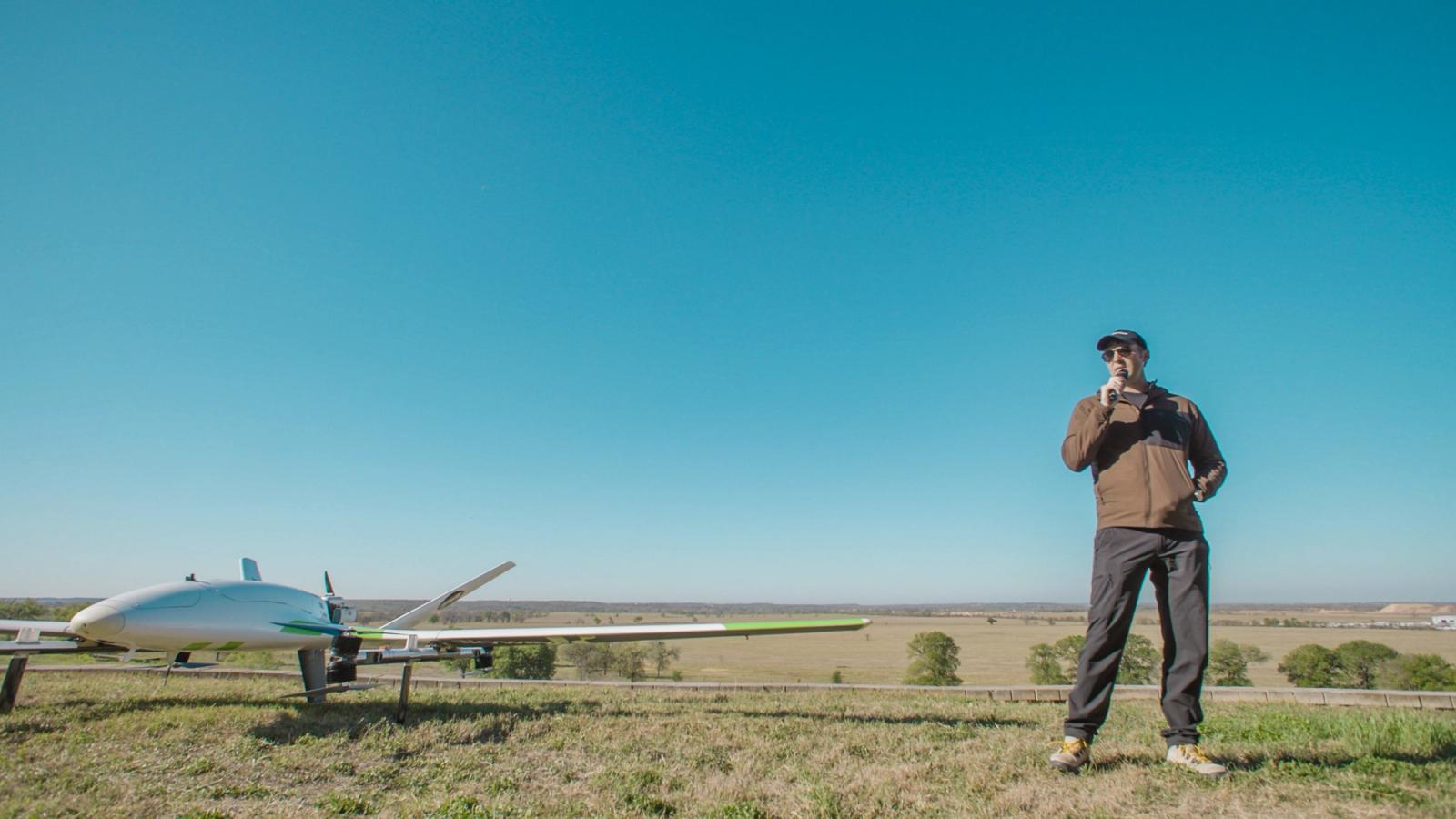
If you walk into the right room at Skyways on the right day, you'll find a whiteboard that looks less like a plan and more like a dare.
On one side: defense pathways. Ship resupply. Island logistics. Allied partnerships across the Indo-Pacific. On the other: commercial lanes, customer leases, flight-as-a-service economics, regulatory approvals stacking up across continents. Lines connecting them. Lines contradicting them. Timelines, funding milestones, headcount targets. Somewhere near the top, in Charles Acknin's handwriting, the destination: the largest unmanned aircraft fleet in the world. Then, eventually, people inside.
It's the kind of whiteboard that makes a business school case study look like a napkin sketch. Defense and commercial. Domestic and international. Cargo today, passengers tomorrow. Every arrow depends on three others. Every timeline assumes things that haven't been built yet.
Charles draws the destination. Isaac Roberts maps the route.

A Navy veteran who spent twelve years after his service building computer vision and robotics companies – including founding Scythe Robotics – Isaac joined Skyways roughly two years ago as Chief Commercial Officer. He's now transitioned to Chief Strategy Officer, a role that reflects both what he's already built and where the company needs to go next.
"My job is to not have a job," Isaac says. "To steer things in the right direction, then step out of the way so I can focus on what's next."
It's a philosophy he's proven out in practice. Isaac doesn't describe strategy as a slide deck. He describes it as something you build until it can stand on its own – then you backfill yourself and move to the next challenge.
That whiteboard full of arrows? Isaac's mandate is to turn each one into a concrete step the company won't trip on.
When Isaac joined, Skyways had already proven the aircraft worked. Defense contracts were active. Missions were real.
What didn't exist was a commercial system sturdy enough to support scale.
Commercial aviation doesn't resist new platforms because of physics. It resists them because of complexity. Certifications. Operating structures. Insurance. Regulatory frameworks. Economics that must pencil over years, not months. Even if the aircraft performs, the surrounding infrastructure can stall adoption.
That was the gap.

"The barrier to adoption in commercial aviation is too damn high" Isaac explains. "SpaceX deals with hard problems – putting rockets into space because it's hard physics. Aviation has a hard time because it's bureaucratic."
Isaac started with first-customer leases and aircraft deployments. Then the deeper work: bill-of-materials discipline, cost-down pathways, sub-two-year payback targets. A flight-as-a-service model that lets customers access capability without owning aircraft, hiring pilots, or navigating regulatory burden themselves.
The model is simple to describe and difficult to execute. Customers lease capability. Skyways handles operations and compliance. The customer gets mission outcomes.
"Customer empathy is surprisingly rare for engineering teams in deep technology," Isaac says. "What Skyways had is a bunch of aviation nerds who woke up every day excited about pushing boundaries on aviation. My job was to translate that into commercial value."
Aircraft deployed. Revenue flowed. Unit economics held up under scrutiny.
The foundation didn't crack.
As the company grew from twenty people to forty – with a target of one hundred or more to meet the workload ahead – the demands changed. A $37 million STRATFI award. Commercial aircraft on lease. International conversations moving from exploratory to active.
Growth brings its own constraints.

Skyways' V3 operates like an autonomous Cessna. But many of the contracts that matter in aviation are still run by general aviation operators who have little exposure to drone technology. There's a gap between the FPV drone world and the people who run general aviation contracts. Someone needed to bridge it.
William Wimberley joined as Chief Commercial Officer to do exactly that.
"Bill has the Rolodex for the entire general aviation space," Isaac explains. "There's a chasm between FPV drone pilots and the people who run general aviation contracts. Bill can bridge it."
The handoff itself was a milestone. If commercial infrastructure only works when its architect runs it personally, it isn't infrastructure. It's dependency. Isaac built something mature enough to step away from.
"We realized there's a lot more to do, and I put enough structure in place to backfill myself in the CCO role so I can move forward and expand into other areas of the business," Isaac says. "There's a tremendous amount the company is taking on. But the foundation needs to be there in order to take advantage of it."
Now, it is.
There's a reason defense infrastructure matters to Isaac personally.
Logistics is one of the most dangerous parts of military operations. A significant share of U.S. military casualties occurs during logistics missions – convoys, resupply runs, equipment transfers. Isaac has friends who were hurt in combat moving materiel from one location to another. Batteries. Ammo. Blood. Triage supplies.
"I've met guys who have been hurt in combat trying to move equipment from one place to another," Isaac says. "Skyways is uniquely positioned to add a ton of value there."
For Isaac, defense business development isn't an abstract growth strategy. It's about reducing risk for people he knows. People doing dangerous work moving cargo that an unmanned aircraft can carry without putting a crew in harm's way.
Before Isaac joined, Skyways had no dedicated defense-business-development effort. Charles had been the sole person managing those relationships. As the company scaled – with operations now spanning three continents and customers including Japan's Maritime and Air Self-Defense Forces – the bottleneck became clear.
"The future is always present somewhere," Isaac says. "It's just not widely distributed. Being able to focus on widely distributing this technology into the DoD and standing up a machine that's going to do that in perpetuity. That's incredibly impactful for me personally."

Isaac's mandate as Chief Strategy Officer is clear: Find the concrete steps from today to the world's largest unmanned fleet and eventual human transportation.
What that means operationally starts with dual-use architecture. Skyways isn't defense or commercial. It's both. The same aircraft moves cargo for active duty military and for commercial customers. The regulatory pathways, partnership ecosystems, and operational infrastructure need to support both simultaneously.
"Whether you're moving active duty military or civilians, the aircraft just does both," Isaac says. "The way those interplay – there's a lot of strategy involved in that."
Part of that strategy is lowering barriers to entry for an entirely new ecosystem. Isaac is working on modular payload architecture – CubeSats for airplanes, as he describes it – to open the platform to payload manufacturers, camera makers, and inspection operators who aren't yet in aviation.
"I'm excited about helping people that aren't yet in the aviation industry tap into it," Isaac says. "This is a very deflationary technology. I'm excited about bringing costs down for the industry across the board."
Beyond partnerships, Isaac is working with Charles on M&A strategy, positioning for Series B, and international expansion. The distribution model extends to allied partnerships and scaling dual-use architecture into markets where autonomous flight capability creates compounding advantage.
"Charles has the goal of building the largest aircraft fleet in the world," Isaac says. "Turns out there are a lot of intermediate steps. I'm being asked to make those a lot more concrete so that we don't trip."
The commercial foundation is set. The handoff is complete. Operations continue.
Now the work expands. One deliberate step at a time.
Isaac Roberts is the Chief Strategy Officer at Skyways, an autonomous aviation company building the world's largest unmanned aircraft fleet. A Navy veteran, Isaac spent twelve years after his service building computer vision and robotics companies, including founding Scythe Robotics. He joined Skyways as Chief Commercial Officer, where he built the company's commercial infrastructure from zero – establishing customer leases, unit economics, and a flight-as-a-service model – before transitioning to CSO to focus on scaling dual-use architecture, defense business development, and international expansion.
Isaac's CSO mandate focuses on turning Skyways' long-term vision into concrete, executable steps. Key areas include dual-use architecture that serves both defense and commercial customers with the same aircraft and operations, defense business development infrastructure, partnership ecosystem development including modular payload architecture, M&A strategy, Series B positioning, and international expansion. The role exists because of the strategic complexity inherent in scaling a dual-use autonomous aviation company across multiple continents and customer segments simultaneously.
Flight-as-a-service means Skyways owns and operates the complete logistics solution rather than selling aircraft to customers. Customers lease capability – contracting for mission outcomes while Skyways handles aircraft operations, maintenance, regulatory compliance, and system improvements. This model lowers the barrier to adoption for commercial aviation customers by removing the need to own aircraft, hire pilots, or navigate regulatory frameworks independently.
After two years as Chief Commercial Officer, Isaac had built a commercial foundation mature enough to hand off – including customer leases, unit economics, flight-as-a-service infrastructure, and repeatable sales processes. William Wimberley joined as the new CCO to scale those commercial operations. The transition allowed Isaac to focus on broader strategic priorities: defense business development, dual-use architecture, international expansion, and ensuring the company has concrete intermediate steps between today's operations and the long-term vision of the world's largest unmanned fleet.
Dual-use architecture means the same aircraft, crews, autonomy systems, and operational infrastructure serve both defense and commercial customers. Skyways aircraft resupply military destroyers and deliver cargo to offshore wind turbines using the same platform and procedures. Defense missions fund infrastructure and prove reliability under the most demanding conditions, while commercial operations increase aircraft utilization and improve unit economics. The strategic challenge is building regulatory pathways, partnerships, and operations that support both simultaneously.
Modular payload architecture draws from an open-source framework established by the Department of Defense in 2021 to align drone and payload manufacturers on universal specs — ensuring maximum compatibility across the broader product ecosystem. Isaac describes it as CubeSats for airplanes: a standardized framework that allows payload manufacturers, camera makers, inspection operators, and other industries to plug compatible payloads into Skyways' aircraft platform. The goal is lowering the barrier to entry for organizations that want to access autonomous flight capability without building their own aircraft or aviation expertise, opening the platform to industries not yet in aviation.
Ten minutes into our first conversation, you’ll know you found the right partner. We ask the right questions, identify and propose the best solutions, and follow through down to the detail with exemplary build quality.